The performance of oversized curved tempered glass depends on four quality gates: optical distortion, lamination yield, arc precision, and one-piece forming at large format.** Xunyuan Glass operates its own bending and tempering lines, with a maximum arc length of 8m, maximum panel size of 6m × 8m, and thickness coverage of 5–19mm.
Curved glass passes through forming, tempering, and lamination. Each stage introduces deformation. This article breaks down the four quality gates — how the defect presents, its process cause, and how we control it.
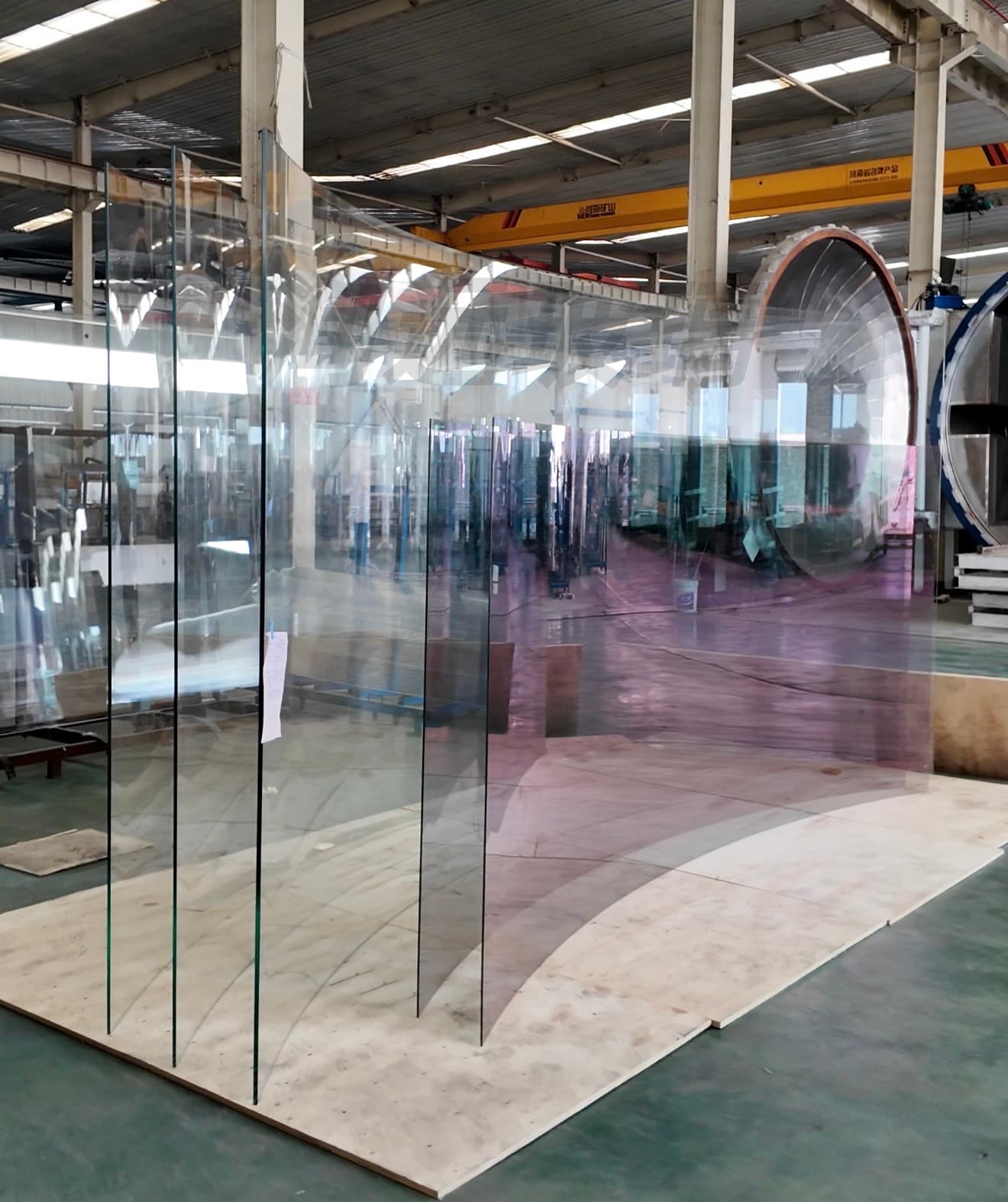
Gate 1: Visible optical distortion
How the defect presents: Reflected lines on the arc surface appear stretched and warped. A single panel is hard to judge; once assembled into a full facade, the overall visual reads as inconsistent, even with ultra-clear glass. Raised at client acceptance.
Process cause: Curvature varies across the arc, so cooling rates during tempering differ by location, producing localised stress variation that manifests as flatness and wave distortion. Raw glass grade, interlayer thickness uniformity, and interlayer refractive behaviour further compound the effect.
How we control it
1. Tempering stress controlled in zones across the curvature. This is the core action against distortion. Rather than applying one parameter set to the whole panel, the arc is divided into curvature bands — the flatter crown zone and the steeper side zones each receive their own heating temperature and quenching air pressure. The aim is to equalise stress point to point and remove the localised undulation at source. This happens at the tempering stage and requires zoned-control capability on the equipment.
2. Raw glass specified by location. Primary visual faces can be specified in ultra-clear glass, with grade and brand agreed in the order and supported by the glassmaker's data. This is settled at order confirmation and material preparation — it determines how good the base is.
3. Interlayer thickness uniformity controlled separately. Uneven thickness introduces refractive offset, which compounds perceived distortion. Interlayer thickness uniformity is therefore broken out of general raw-glass configuration and managed on its own.
4. Flatness and wave distortion within national standard ranges, parameters tuned per order. These are not fixed values — they are tuned to the curvature character of each order. Parameters for a large-radius, shallow arc do not transfer to a small-radius, steep arc.
5. Process prediction at the detailing stage. Once drawings arrive we assess the curvature distribution across the panel and identify where distortion risk concentrates, fixing the parameter plan up front. This happens in detailing and process review — moving risk onto paper rather than discovering it after production.
What you gain: reflected lines on the arc remain continuous, and the assembled facade reads as one visual whole. Client acceptance is less likely to stall on the "looks hazy" question, reducing rework and dispute over perceived quality.
How to verify: Inspect reflected lines for continuity at multiple distances and angles; ask for an explanation of the zoned tempering approach.
Gate 2: Low lamination yield
How the defect presents: Bubbles, delamination, haze, and edge shrinkage in the interlayer, with a high scrap rate per batch. Rework forces a second scheduling delay and invalidates the original cost calculation.
Process cause: In curved glass the interlayer must conform to a curved surface, so deformation accumulates during pressing. When pressing parameters do not match the actual arc of that batch, bubbles and delamination follow. Parameters drift in batch production; without per-order calibration, early panels pass and later ones fail.
How we control it
1. Laminated structure configured to the project location and design requirements. Not every location takes the same build-up. Facade faces, curved shop windows, and lobby partitions differ in loading condition and visual requirement, so the interlayer solution is configured to match. This is settled during drawing detailing and structural confirmation.
2. Pressing parameters tuned per order. This is the decisive action for yield. Parameters are never carried over from a previous job — before each order goes into production, the temperature, pressure, and time curve is recalibrated against that batch's actual arc. This step happens before every production run and is where yield variation is won or lost.
3. Forming verification before lamination. Before panels enter the lamination line, we confirm that the deformation after forming falls within the controllable range. Panels outside it do not go in — avoiding the whole-batch scrap that follows from discovering the problem after pressing. This gates the handover between forming and lamination.
4. In-process sampling during batch production. Temperature and pressure drift slowly in continuous runs. Sampling catches the drift and allows parameters to be pulled back, preventing the progressive failure pattern where early panels pass, the middle develops minor faults, and the tail is clearly out of spec. This runs across the whole batch.
5. Edge sealing handled separately. Panel edges are where delamination and shrinkage concentrate on curved glass, so edge sealing is broken out of the routine sequence and controlled on its own.
What you gain: batch scrap rate comes down, so a quote costed at normal yield actually holds; no second schedule slip from rework; batch quality is stable and panels do not need hand-sorting on arrival.
How to verify: Ask how pressing parameters are determined — per-order tuning or template reuse. Inspect edge sealing quality.
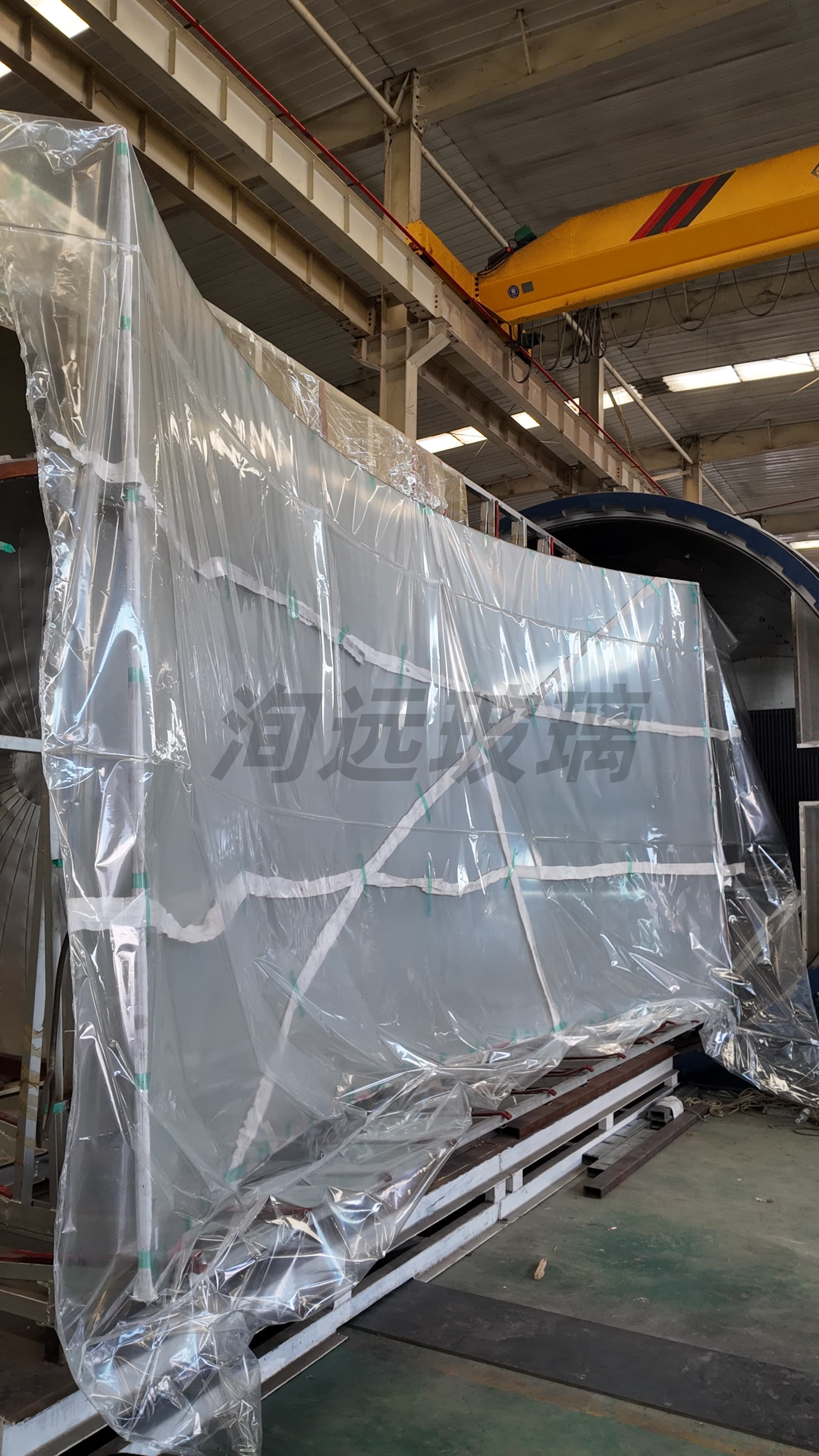
Gate 3: Arc precision deviation
How the defect presents: Panels within one batch do not match in curvature. On site, some seat properly against the frame while others leave gaps, forcing impact or shimming that concentrates stress.
Process cause: Variation in mould conformity, softening temperature, and holding time during forming; curvature springback during quenching not compensated; absence of first-article verification and in-process sampling in batch production, so parameter drift goes undetected.
How we control it
1. Arc verification before drawing release. From the drawing's arc, arc length, and radius we derive forming temperature, holding time, and mould matching — settling how the panel will be made while it is still on paper. This is the start of the precision control chain, done at the detailing stage.
2. Springback predicted and compensated. Glass springs back during quenching, so the finished arc "opens up" slightly relative to the formed shape. We predict that springback during parameter design and compensate in the opposite direction, bringing the finished arc back to the drawing requirement.
3. Production parameters tuned per order. Forming and tempering parameters are reset for each order's actual arc rather than carried over from a previous job.
4. First-article verification plus in-process sampling. Production starts with a first article; volume begins once it passes. Sampling then continues through the run to catch parameter drift early.
5. Flatness and wave distortion within national standard ranges. These two support arc precision — if flatness is out, arc accuracy alone will not carry the visual result on site.
What you gain: panels within a batch share consistent curvature and seat properly on the frame across the run, without impact or shimming on site. Installation efficiency improves, and no stress concentration is introduced by forced correction.
How to verify: Request an explanation of first-article verification; sample multiple panels from a batch and compare curvature on a flat bed.
How the defect presents: Large panels cannot be formed in one piece and must be segmented, breaking up the visual continuity of the facade. More segments means accumulated error and harder flatness control across the face.
Process cause: Arc length and panel size are bounded by the furnace working envelope. Larger panels accumulate more deformation during heating, narrowing the stress control window — the larger the achievable size, the smaller the margin for process parameters.
How we control it
1. Arc length capability. Maximum arc length 8m. That number is what decides whether a large curved face can be formed as one piece rather than cut into segments. Long arcs depend on the furnace working envelope and the matching forming process.
2. Panel size capability. Maximum panel size 6m × 8m, oversized 6m × 8m / extended length 3.3m × 20m. The larger the panel, the fewer the seams, and the better the visual continuity of the elevation holds up.
3. Full thickness coverage with multiple process routes. Thickness 5–19mm across the range, with flat tempering, bending, heat bending, and irregular bending available. Different locations can use different processes without the design being bent to fit manufacturing limits. Irregular locations are assessed individually against the drawing.
4. Stress parameters for large panels tuned separately. Large panels accumulate more deformation and offer a narrower control window, so their production parameters are set independently rather than sharing a single set with small panels. This step is at parameter setting and is the dividing line for stable output at large format.
5. Packing and transport support. A panel that can be made must also be deliverable. We provide dedicated packing schemes for oversized panels and lifting guidance, and can plan transport piece by piece. Lifting itself remains the contractor's responsibility; our role is scheme coordination and on-site advice.
6. Own production lines, start to finish. Forming, tempering, and lamination all run on our own lines, so the parameter chain is short and controllable. Each outsourced step adds one more layer of distortion in parameter transfer — what was predicted upstream drifts downstream.
What you gain: the large curved face the design calls for can be made in one piece, so the elevation is not cut up by seams; fewer segments means less accumulated error and easier control of overall flatness; oversized panels ship with a matching packing scheme, lowering damage risk on arrival.
How to verify: Request the equipment list; confirm the drawing's arc length and panel size fall within the above ranges.
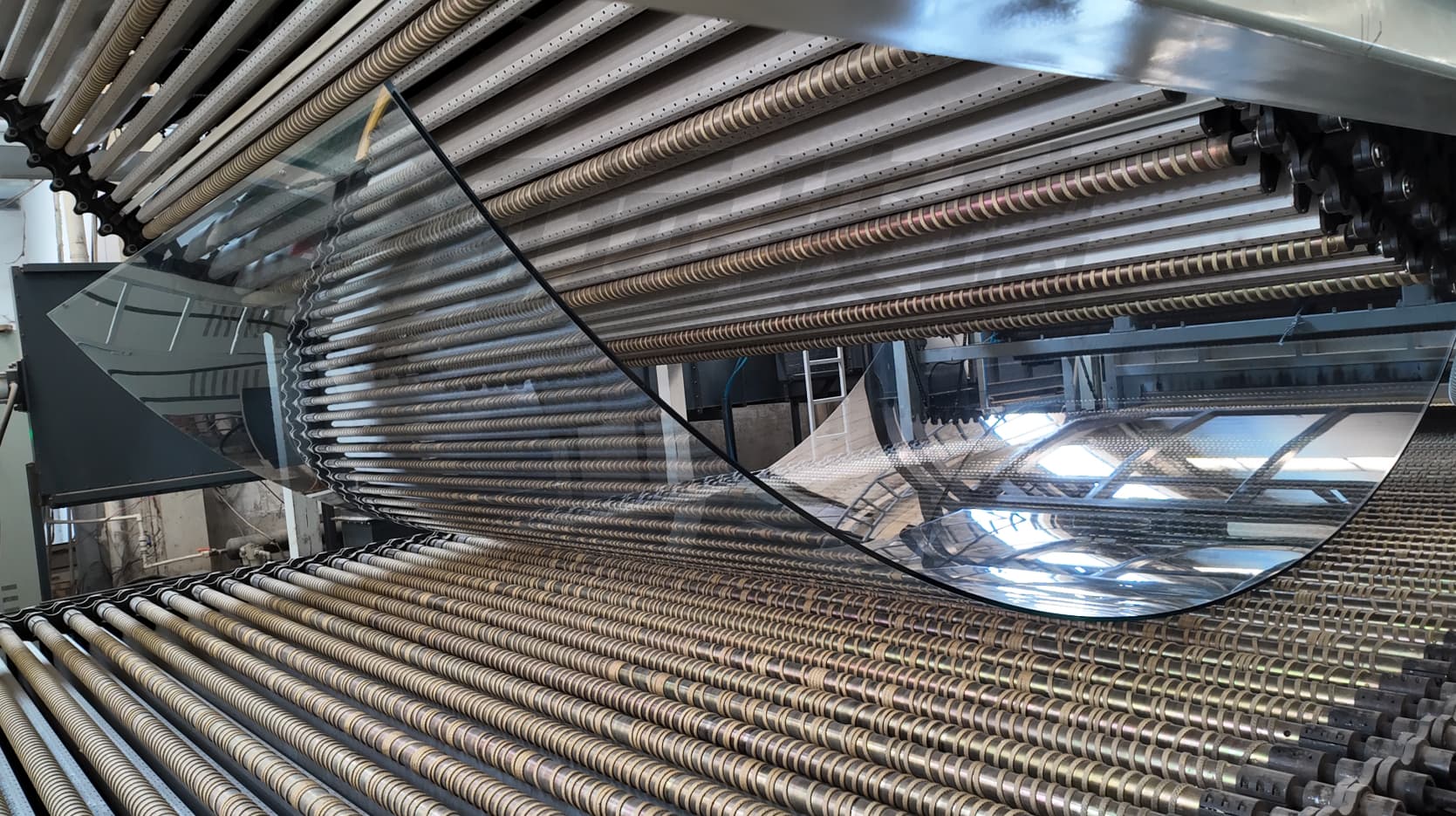
Radius fit
Minimum radius from 300mm for standard bending, from 350mm for irregular bending.
Note the inverse relationship between arc length and radius: a smaller radius means a shorter achievable arc, because curvature change per unit length is greater and stress control correspondingly harder. Large-arc facade faces and small-radius irregular returns are therefore different process routes, assessed separately per drawing.
Quality tiers
| Tier | Application | Process configuration | Quality benefit |
|---|
| Standard | Moderate arc, large radius, general visual requirements | Standard bending, flatness and wave distortion to national standards | Stable cost and lead time |
| Visual | Facade primary faces, showroom windows | Zoned tempering stress control + ultra-clear raw glass + interlayer thickness control | Reduced perceived distortion |
| Precision | Batch assembly, tight structural alignment | Arc verification up front + per-order parameter tuning + first-article verification | Improved batch consistency |
| Integrated | Oversized panel + long arc + lamination | One-piece forming + per-order lamination calibration + oversized packing scheme | Fewer seams, less rework |
Delivery and coordination
CAD files or a sample; developed shop drawings within 24 hours, free of charge
Assistance with glass selection, structural load calculation, and node detailing
Dedicated packing schemes for oversized panels and lifting guidance
Scope: manufacturing, processing, shipping; installation not included. Lifting remains the contractor's responsibility
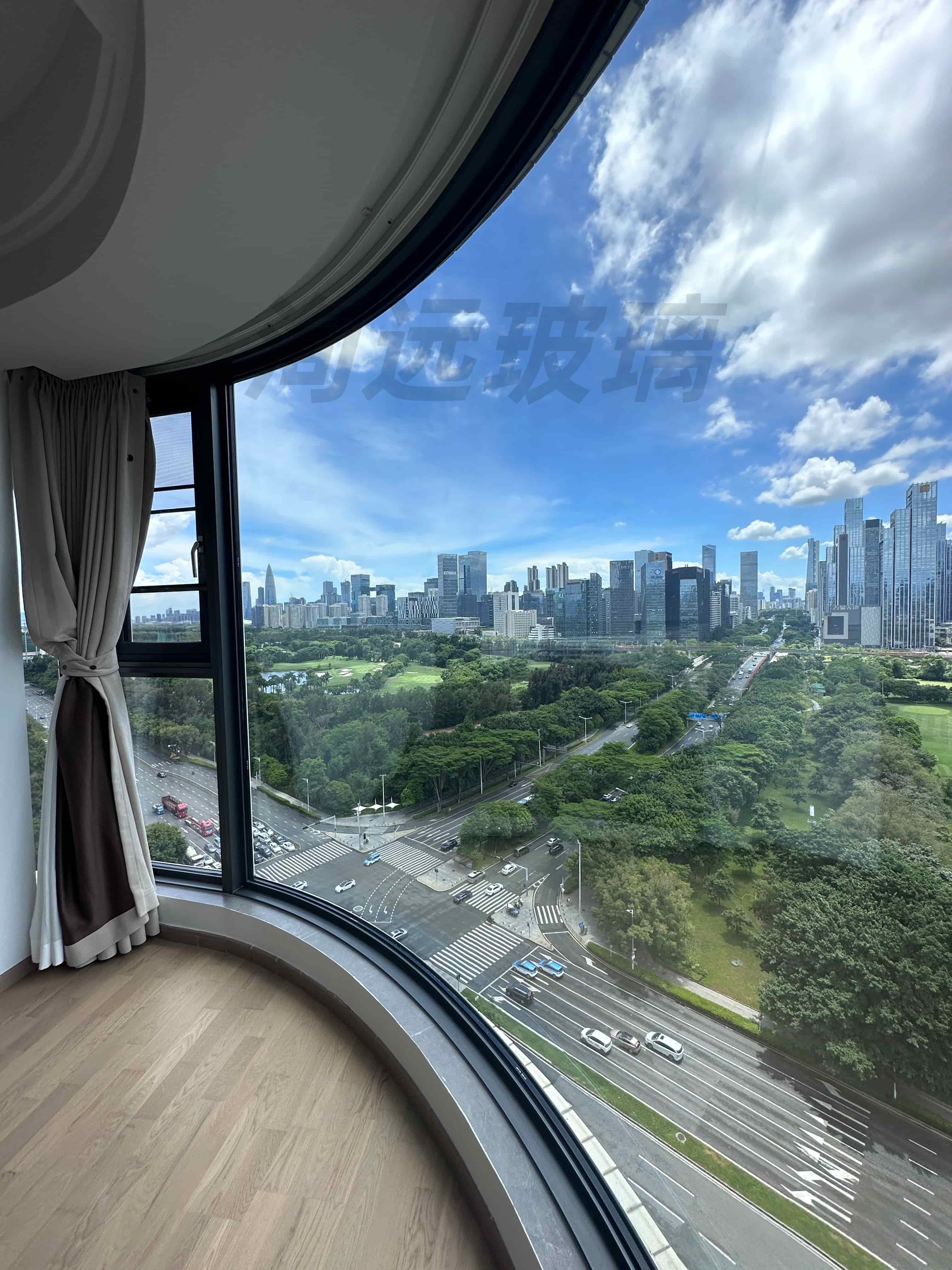
The common thread
Optical distortion, lamination yield, arc precision, and large-format forming look like four problems. They point to one thing: whether the arc's deformation during forming and tempering is predicted and controlled.
In practice that means four activities running through all four gates:
Forming verification — parameters derived from the drawing up front, deformation predicted on paper and high-risk zones identified.Per-order parameter tuning — zoned tempering stress, pressing curves, and forming temperatures all recalibrated to each order's actual arc, never carried over from a template.First-article verification — a first piece is checked and passed before volume begins.In-process sampling — drift is watched through the run and corrected as it appears, so deviation never accumulates to the tail.
These four rest on a single condition: our own lines, start to finish. Each outsourced step adds a layer of distortion in parameter transfer, and what was predicted upstream drifts downstream. Where control holds, output is clean, consistent, and assemblable.
Submit drawings at www.xunyuanglass.com for a process assessment across the four gates.