When a curtain wall, curved partition or panoramic elevator project moves from CAD drawings to glass procurement, the first question is always the same: "Can you actually produce this spec?" Curved tempered glass is a made-to-order product, and fabrication limits vary significantly from one processor to another. For extra-large one-piece panels, tight bending radii or multi-process combinations, many suppliers accept the order only to outsource it later — putting both quality and lead time at risk.
In practice, feasibility comes down to three core fabrication limits.
1. Size Limit: One-Piece Panels Without Splicing
Commercial facades and flagship show windows usually demand single panels with no intermediate joints — every splice is both a visual compromise and a potential leak point.
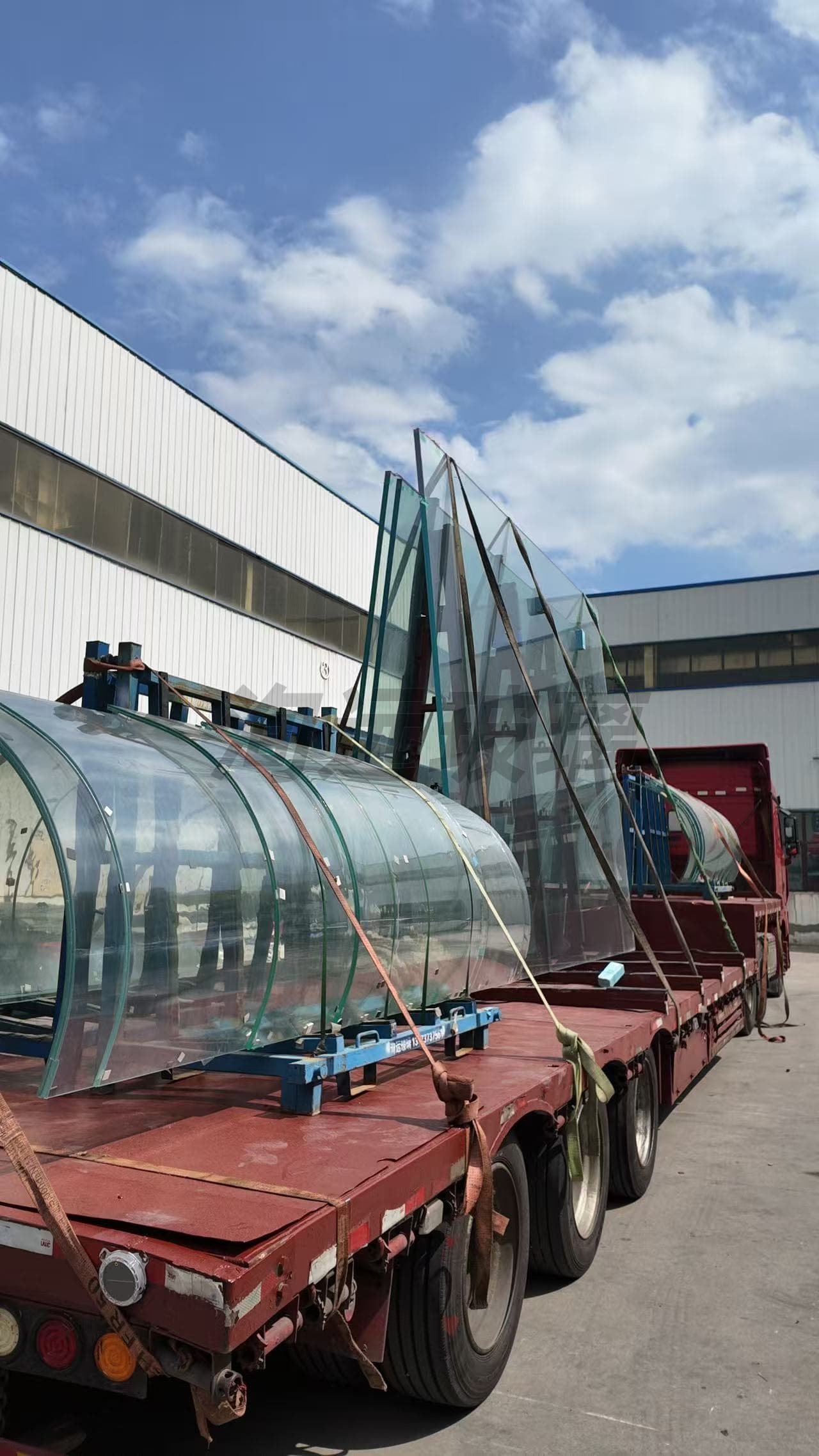
Typical industry capability: flat tempered glass up to 3-4 m wide and 8-10 m long; curved tempered glass mostly within a 6 m arc length and 4.5 m height. Leading source fabricators go further. Xunyuan Glass operates ultra-wide tempering furnaces producing flat tempered glass up to 6 m wide and 13 m long, and curved tempered glass with a maximum arc length of 8 m and height of 6 m — covering the one-piece requirements of most large commercial curtain walls and skylights.
If a design exceeds a fabricator's limit, the realistic options are re-segmenting the design or sourcing from a larger plant. Pushing an over-limit order through usually ends in dimensional and flatness problems.
2. Bending Radius: The Recognized Process Threshold
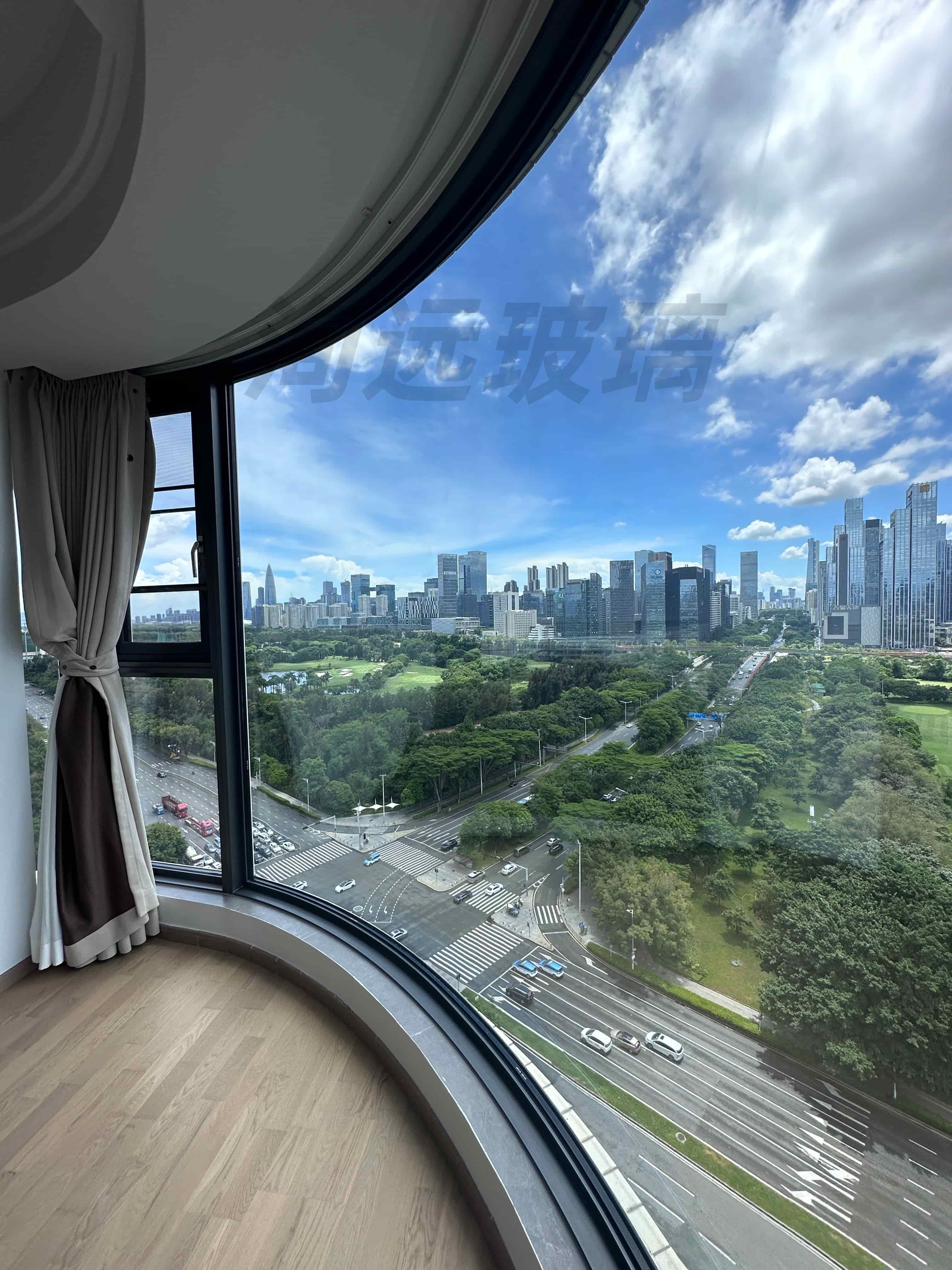
The smaller the radius, the harder the job. Curved tempering heats the glass to its softening point, bends it to the set profile, then rapidly cools it. At very small radii, uneven heating or poorly controlled cooling stress easily results in waviness and a higher spontaneous-breakage rate.
Most processors work above a 500 mm minimum radius. For 300-400 mm small-radius work, you need a source plant with finely tuned furnace parameters. Xunyuan Glass has calibrated its heating and cooling parameters to achieve a standard minimum radius of 300 mm, and 350 mm for J-shaped, hook, S-curve and spherical bends, with holes, notches and rounded-corner detailing available for high-precision applications such as panoramic elevators and curved railings.
Do not rely on verbal promises — ask for a sample piece or case photos of the same specification.
3. Combination Processes: Watch the Handling Between Steps
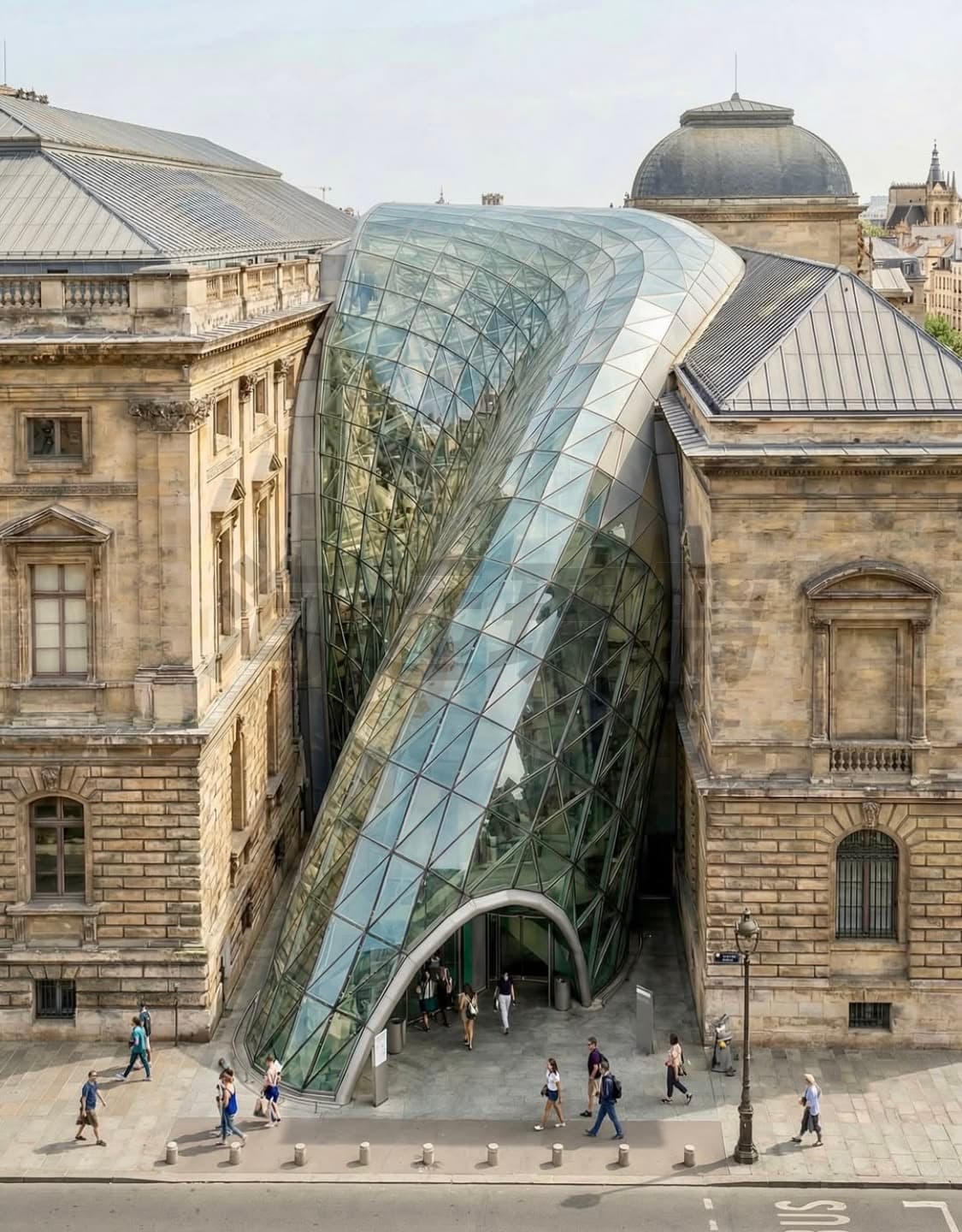
Most projects call for laminated or insulating curved tempered units, sometimes with Low-E coating or ceramic frit. The glass must first be bent and tempered, then laminated or assembled: curve-to-curve fit-up, uniform interlayer distribution and deformation control all depend on process experience. If tempering happens at one plant and lamination at another, every transfer amplifies dimensional error and delay.
Before ordering, confirm two things: whether the combined process can be completed within one plant, and whether comparable project references exist.
Capability Summary — Xunyuan Glass
· Flat tempered glass: up to 6,000 mm × 13,000 mm
· Curved tempered glass: arc length up to 8,000 mm, height up to 6,000 mm
· Minimum radius: 300 mm (standard bends); 350 mm (J-shape, hook, S-curve, spherical)
· Edge detailing: holes, notches, rounded corners
· Combinations: curved laminated / curved insulating (specifications subject to confirmation)
The bottom line: size tests the equipment limit, radius tests the process control, and combination tests the in-house capability chain. Verify all three item by item, request a sample, and you will avoid the classic trap of "order accepted, quality rejected."
Send us your drawings for a feasibility review and quotation.